
Today, we walked 15,500 steps…but every step led to something wonderful. We started off with a short walk around the hotel neighborhood with Kieran, the Viking guide who will be with us until we depart from Prague. On this short tour, we mostly learned about Kieran, who is a tall, middle-aged Brit who likes to eat a lot! He has apparently tried every restaurant in the area and uses the word “phenomenal” when describing almost any food! The one exception was when we got to the Indian street. He pointed to one sign and said, “I’m sure it’s good, but they lost me at ‘vegetarian’.” So that’s our Kieran, definitely a carnivore.
After the neighborhood walk, John and I decided to set out and wander around on our own. Our first goal, the Brandenburg Gate, a great landmark that took us down Unter Den Lindon (a historic walk under the Lindon trees) and part of the border of former East Berlin. From there on, we were 100% in former East Berlin, where lots of gorgeous buildings still stand—or have been heavily repaired after WWII and the wall coming down.

There is no denying the damage from WWII in this country or the suffering that the Nazi’s caused the Jewish population. (WARNING: TOUGH HISTORY AHEAD) On our afternoon tour of the Jewish Quarter, we learned that the Jewish extermination in Germany happened in stages. Stage one was that everyone had to do their family history and declare their religion. At this point, all Jews were recorded as being Jewish, even if they were only a small percentage Jewish. Then came the wearing of the star. All the while, the government encouraged Jews to leave the country by any means. Those who were younger and could escape did. Those who were older and established did not. In the end, the Jewish population was reduced from 500,00 to 214,00 people just by relocation and comprised less than 1% of the German population.

Anyway, you know all this, but: Interesting fact—There were 186 transports of Jews to concentration camps from Berlin. The first train took 1000 people, and the last train took 12 people. Most of the Jewish population was in Poland, where there was no escape and where the extermination camps were located.


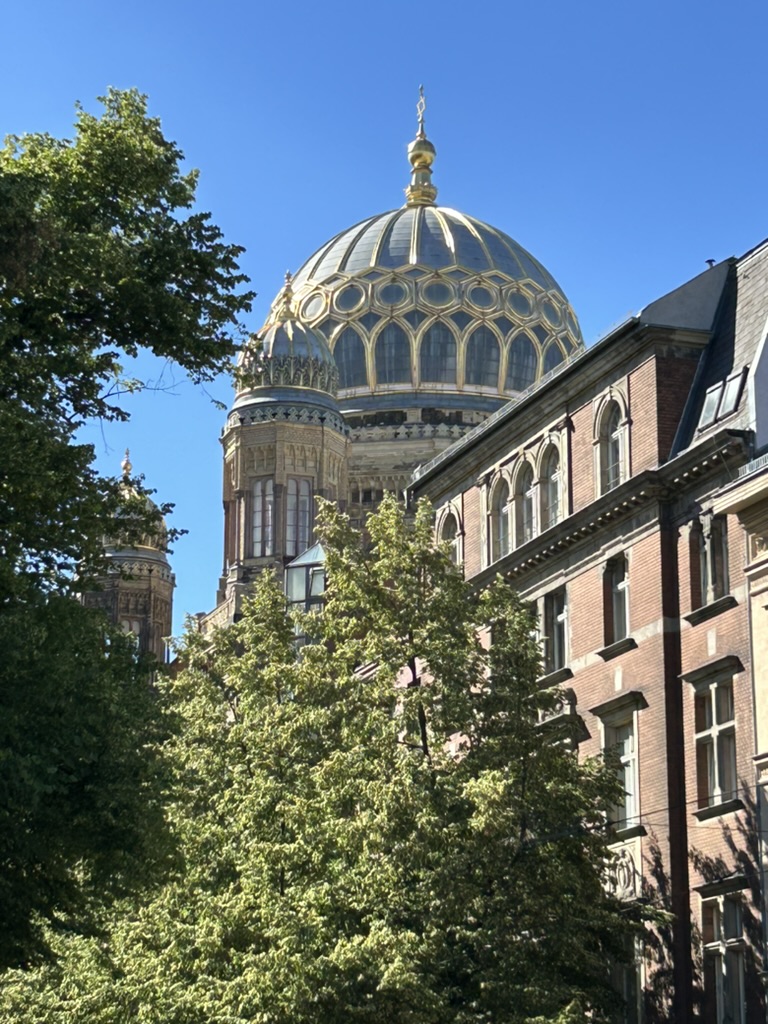
Our walking tour took us from St. Mary’s Church to the Old Synagogue, to the monument to all the women who protested the arrest of their Jewish husbands (and managed to free them!), to a telephone pole pasted with records of people transported, to the Otto Weidt Workshop for the Blind (a terrific museum with miraculous stories of survival—very moving, in a positive way), to the oldest Jewish cemetery where Felix Mendelssohn’s grandfather is buried, to a memorial of women and children, and to the New Synagogue —a spectacular building, heavily damaged in the war and partially rebuilt. Sadly, we could not visit the museum there because of visiting dignitaries and heavy security.


The most amazing stories were the survival of Inge and Alice, two of Otto’s employees. He even had his driver take him to Auschwitz to free Alice. When he found out that she’d been moved, he had his driver take him to the new concentration camp where he secured her release. So many extraordinary stories in this country!

What you see is all there is, however. There is no backside and no inside. A small museum has been added, but there was so much damage from WWII that total reconstruction was not possible (they say).
The Germans know how to give a tour. This was highly informative and rich in new information. We were gone for four hours without a water or ice cream stop, and no one had to go to the bathroom! (Probably because we were all dehydrated!) We didn’t lose a single person, but when we returned, everyone wanted a beer! Good way to keep the hotel in business!
Our last stop! We ended up sitting with some delightful Germans who, at the end of our dinner together, invited us to the unveiling of the Jehovah’s Witness war memorial statue tomorrow in the park. What a day…