
(Tap title for more.)
Kutna Hora, which translates to “a mining town for silver”, was a place famous for having many very rich churches in a small area. Silver built them, then Plague, famine, and wars came, and so came the bones of the dead. The big thing that the town is famous for now is rather gross, frankly. It’s their huge collection of human bones. They have hundreds of thousands of bones dating way back. What they’ve done with them now is the gross part. They’ve used the bones and skulls as an art medium. Thankfully, we weren’t allowed to take photos, but I took this photo of a photo of the chandelier. We couldn’t wait to get out of there.

You’re going to thank me later for showing you this— I know, I know, on to the next attraction. It gets better, I promise!

The Lego store in town stayed in the theme. Tiny town, tiny Lego store, but they do have a sense of humor! The theme of the city seems to be “memento mori”: Remember you will die. Or, what we are, you will become. So cheerful. It’s supposed to be a dandy place at night! No kidding, they have nighttime tours by candlelight, led by nuns in robes. C-r-e-e-p-y!

The Church of All Saints (souls also reside here) is a Gothic structure sitting directly above the charnel house of bones. It dates back to 1142 and is in need of repair. It was tiny, but charming.

Just a half a block away is Our Lady of the Assumption, dating from the 14th century. Check out the incredible ceiling. The whole church fell into disrepair centuries ago and was without a roof until the 18th century when it was finally rebuilt in the High Baroque —or Baroque Gothic style. There were a few skulls in a glass case and two supposed saints in glass boxes, but I’ll save you from all but light and happiness here.

Love this monstrance and the way this time of day showcased all the shadows. My favorite picture of the day!

This is Saint Barbara (Santa Barbara to us Californians) and a perfect model of late Gothic architecture. This was built entirely with silver mining money and before all the disasters stated. It has glorious flying buttresses and rooftop pinnacles that grow thinner and thinner as if to reach towards the heavens. It’s everything I’ve learned about Gothic churches all in one place.

Since rich mine owners paid for the church, their shields are represented on the ceiling. Check out the chandelier. We see imitations of this style in modern Catholic Churches around town. I think St. Philip’s in Pasadena has a couple.

Here’s an artsy photo of some of the buttresses against a brilliant sky. Like Notre Dame, it has gargoyle spouts and a couple of mischievous characters up there with pants down, mooning the sky— a sign that people can still misbehave even in a holy place.
Met street musicians on the walkway close to the church and on our way to lunch. They were fantastic. I gave them a few centimes (wrong word for small change). Apparently I could have Venmoed the money! Would rather have bought a CD.

Back at the hotel, I snagged a photo of this map, showing where we’ve gone in this gorgeous city.

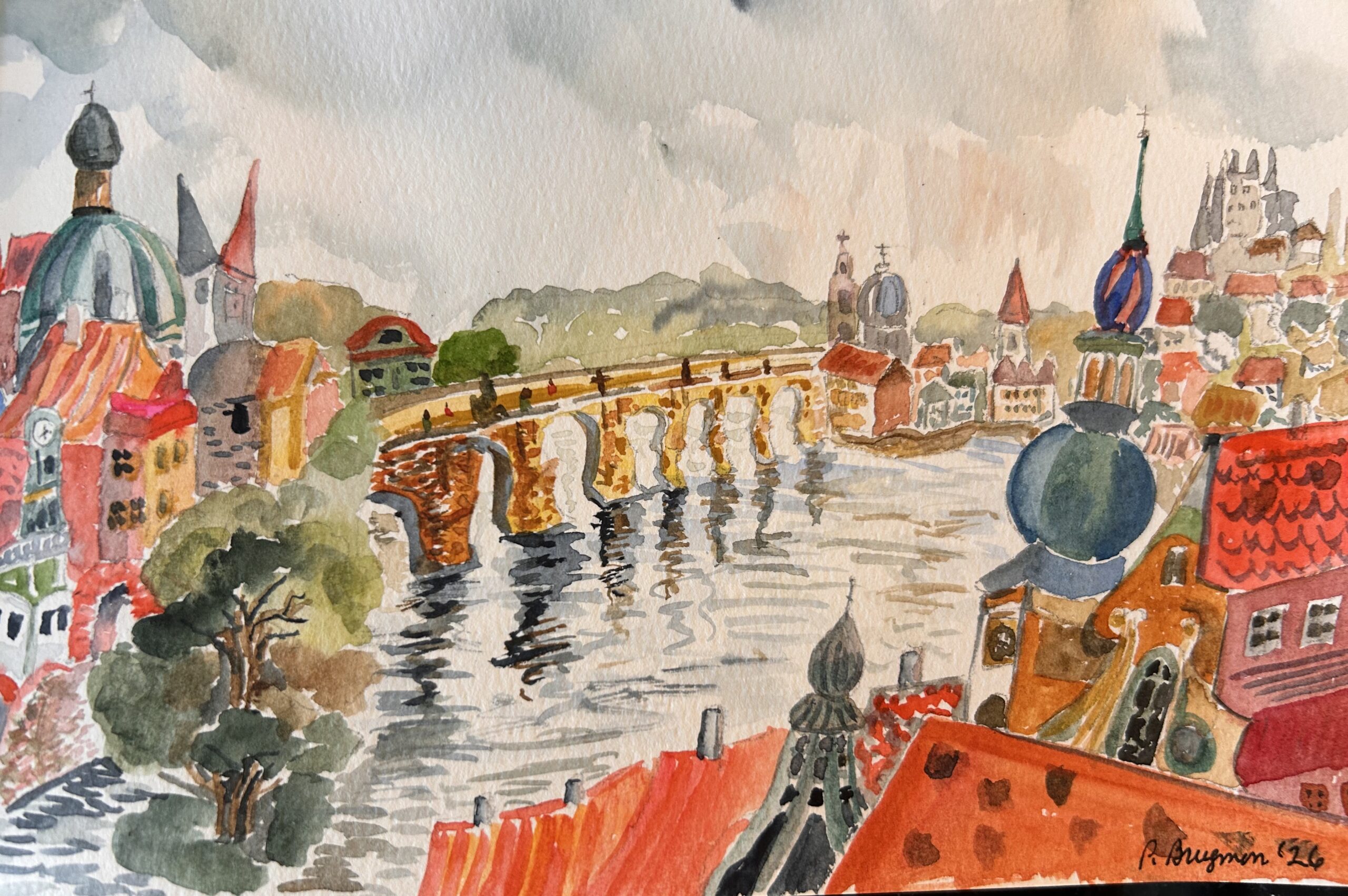
I did this overly detailed watercolor of the things around the Charles Bridge, the real landmark of Prague. See the castle and palace on the hill and the crucifixion on the bridge. Everything here is symbolic of the real Prague.
We met our dinner friends at the nearby restaurant, Apricot. These people, Linda and Craig, added so much to our trip. We hope to meet again!
We hope to meet again!