
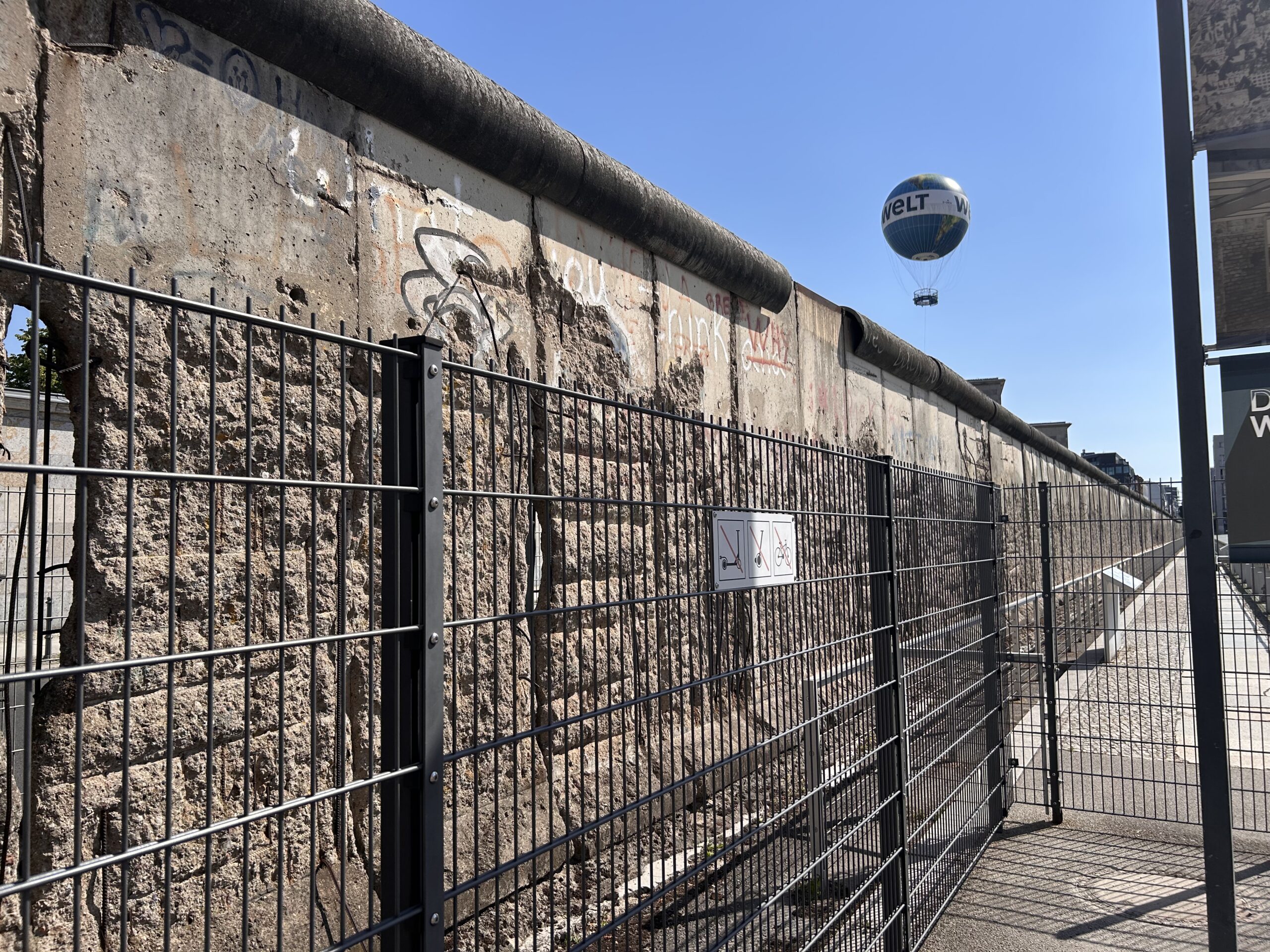
The temperature is going up. We have hats and light colored clothes, but I also have 3 jackets, a sweater, and a sweatshirt, all of which I wish I could make disappear.
Today was not the highlight of the trip, but it was something that we had purposely scheduled. I’m barely recovered from the amazing survival stories from the Nazi persecution, and now it seemed like the same characters had donned Cold War hats to tighten the thumb screws from the Crime and Torture Museum that we had avoided in Rothenburg. I think there’s a trend in human history that is not so good.
The Cold War had a history that went bad when Roosevelt died, and Churchill did not win the reelection. That meant that of the big three, Stalin was the biggest and got everything he wanted— a big chunk of Germany and expansion of Eastern Bloc countries. We all know about The Wall—but the way it went up was just amazing. People were living without a wall for the first 7 years. In 1952, there was an iron curtain that created a manned border along all of East Germany, 700 miles, encircling all of Berlin. Still, in Berlin, people could go back and forth for work or to visit relatives. They could work in the west and go home to the east with just a quick check of “the papers.” Then came The Wall—all at once— on one day, pretty much. August 12, 1961, the announcement was made. The next day, barbed wire was laid down, and train stations were closed. August 13th became known as “Barbed Wire Sunday.”

Then the efforts were to keep people inside the borders. Surprisingly, most people wanted to stay in their neighborhoods and in their jobs, not caring about the government. Slowly, as rules became tighter and people wanted to escape, the orders became “shoot to kill” and a second wall with a “no man’s land” between was built to make crossing all the harder. In total, about 5,000 escaped and even more died trying. There is a memorial wall of about 100, mostly young men.

Today was not a happy day because this tour became more and more oppressive as we walked part of the wall and the space between the walls where so many regular people had died trying to escape to freedom. But first, a cute story. In 1948, during the Berlin Airlift, when the Soviets blockaded all food, charcoal, and meds in protest to West Germany’s creation of the Deutschmark, Allied planes took off every 90 seconds to deliver needed goods to the people below. One of the pilots met a group of kids. Searching for something to give them, he pulled out two pieces of chocolate for 8 kids and announced, “If I give this to you, will you fight over it?” They promised not to, so he gave it to them. Then he watched as those kids carefully divided the pieces of chocolate into smaller and smaller pieces so everyone could have a taste, the last few being happy just to lick the wrapper. The pilot (from Utah) was so touched that he promised to come back tomorrow and drop a whole bag of chocolate just for them. One kid asked, “There are so many planes, how will know which one is yours?” The x answered, “I’ll wiggle my wings so you know it’s me.” And he did and they got the bags of candy. Afterwards, some of the kids wanted to write a thank you note to the pilot but, not knowing who to address it to, wrote to Mr. Chocolate and to Mr. Wiggle Wings. Gail Halvorsen was able to return to Berlin and meet some of those “kids” again on May 12, 2019 at 98 years old— a honored hero, and part of one of the really great stories.
At “The Museum of Terrors,” however, we were faced with a Soviet style of oppression and neighbor-spying that included children informing on their parents without knowing it. Men in suits, the Stasi, asked the sweetie pies, “What shows are your parents watching on TV at home?” Or, “Was your daddy out late last night?” Every other person seemed to be informing on someone in order to keep from going to prison themselves. Concentration camps were opened to house all people who refused to talk. If a son escaped to the west, the remaining family was tortured. One young man returned after the wall came down and heard what his escape had done to the remaining family. He committed suicide. And the stories go on and on. Sadly, all the horrors we heard of communism as children were apparently true.
Okay, time for a bit of humor. Materials were hard to come by in the east and so cars were rare. You could only get one car in your lifetime and you had to wait between 10-15 years after ordering a car and making the down payment. People would actually put in an order for their baby in hopes that their future teenager would be able to drive. Along with the scarcity of cars was a scarcity of skilled laborers. In the East, things that broke seemed to stay broken, so the joke goes: A man goes to the auto dealer to buy a new Trabant. The dealer says, “Ok. You’re all set. Delivery will be 10 years from today.” The man answers, “What time?” The dealer says, “It’s in 10 years; who cares what time?” “I do,” the man says, “Because I have a plumber coming that day!”
Finally, Gorbachov was elected, and Glasnost and the surprise announcement that the wall was coming down. Imagine the scene from “The Wizard of Oz” — “Ding Dong!” —people were filled with amazement and disbelief. The announcement was made by accident on the radio at night that the wall would start to come down at 4 am. People got in their cars (if they had one) or walked to borders, if they didn’t. The guards were confused. Thousands of people waited patiently while phone calls were made. Finally, at 11:59 pm that night, the guards lifted the gates and people streamed through.
With everyone leaving (on the promise that they were just visiting relatives), the wall had to come down. Otherwise, East Berlin would have been a ghost town. Still, it took time and the rebuilding process took forever. Many buildings that we saw were just a few years old because it has taken that long (since 1989) to build up all the available land. Very exhausting day and stories. Glad we went, anxious for something beautiful next. Good night.