
Today was an early start to go to the Valley of the Kings and the Valley of the Queens. We’re still in Luxor, and our destination was a carved-out hill in the desert just across the river, but the bridge was 30 minutes away, that’s the way we went. The site was white Sahara, but just off the Nile watershed, so, if you wanted to, you could stand with one foot in lush vegetation and the other in the desert!


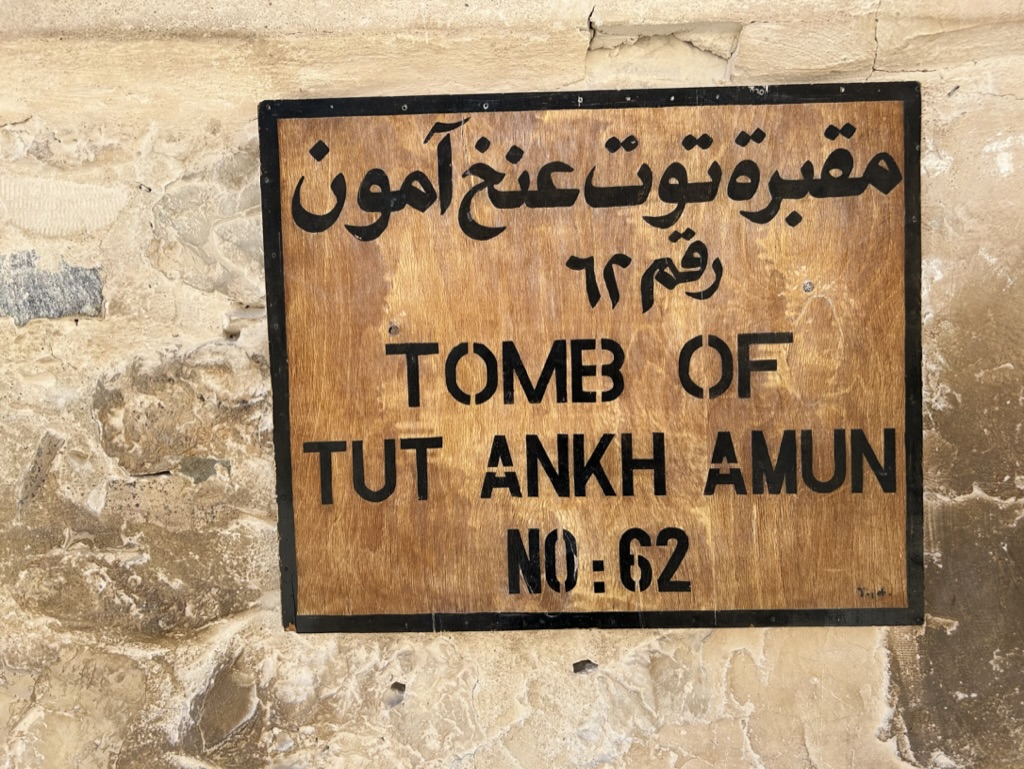
The Valley of the Kings is where Howard Carter, funded by Lord Carnarvon (of Highclere Castle, a la Downton Abbey), found the burial site of Tutankhamun (Too-tahn-kahmen) in 1920. These tombs are not in pyramids because pyramids are advertisements for grave robbers, which the ancient Egyptians soon discovered. As a result, many artifacts were found in this area, though many were also stolen. King Tut’s tomb is highly significant because it was found completely intact. Since it was the most famous, it was the first one we visited. The walls are covered in hieroglyphs with instructions on how to enter the afterlife. Now, only the actual mummy of King Tut and his sarcophagus remain here. All else is in the Cairo Museum and soon to be at the new GEM.


Next, we saw the tomb of Rameses IV, a huge tomb with writing all over the walls and ceiling. It was very deep. 70 stairs down, but so brightly painted, again with no retouching, and 3,000 years of detail in the writing. These walls are all about hieroglyphs and the ancient Egyptian beliefs that the dead became gods through incantations. The writing reads like magic spells.

From the Valley of the Kings, we next went to the Valley of the Queens, where Hatshepsut and Nefertari were buried. Nefertari is the wife of Rameses II and is one of the most beautiful of all the tombs we’ve seen. In fact, we needed a special “E” ticket to be admitted to this one. The Hatshepsut temple was huge, but defaced by her grandson, who wanted to erase her from history. There are still significant records of her reign and complicated married life, so her memory lives on.


Back on the ship, we set sail for the south (upriver). While we cruised, we had a Backgammon lesson and an Arabic lesson so that we can be prepared for some significant shopping tomorrow. John needs a Galabiaya for the party tomorrow night.
After dinner, we had a floor show from an onshore troupe that included three musicians and a whirling dervish! Fabulous colors and an amazing show!
