
Our first stop today was the Citadel, a huge complex built behind a castle wall, complete with battlements. This medieval structure dates back to the 1200s had has housed rulers for 700 years. The central building was a mosque from the 1800s, half built in alabaster. The interior was gorgeous and incredibly intricate. The dome shape is designed for acoustics. There were 365 lamps, now electric, and other sequences of numbers in the artwork. Apparently, it can house thousands of worshipers on a weekly basis.


Next, we boarded the bus for the Cairo Museum, where great statues, small items, and everything in between live. This was an old-fashioned museum, unlike the new GEM that we visited yesterday. It was dark and echoey, with lots of glass and artifacts poorly displayed. Still, it was marvelous. The artifacts here are fabulous. Here, everything is out. If they have 15 amulets, all 15 are on separate shelves of a display case mounted to the wall. We learned the difference between a common man, a king, and a god as portrayed in sculpture. A king wears a crown with a cobra over his forehead. His beard is always straight and squared off, and his hands each hold a rolled-up papyrus as a symbol of his power. If the king is portrayed as dead, his beard has an uplift at the bottom, which indicates that he is now a god.

Then came the big treat. In a small, dark room upstairs was the King Tut exhibit, complete with the solid gold inner coffin, the throne, the crook and flail, and finally the great mask. His mummy will come later when we visit the Valley of the Kings, but this was quite amazing— even in a museum that is nothing like the British Museum or other great museums. Still, here and only here in this museum and in that room only are things that we’ll probably never see again.

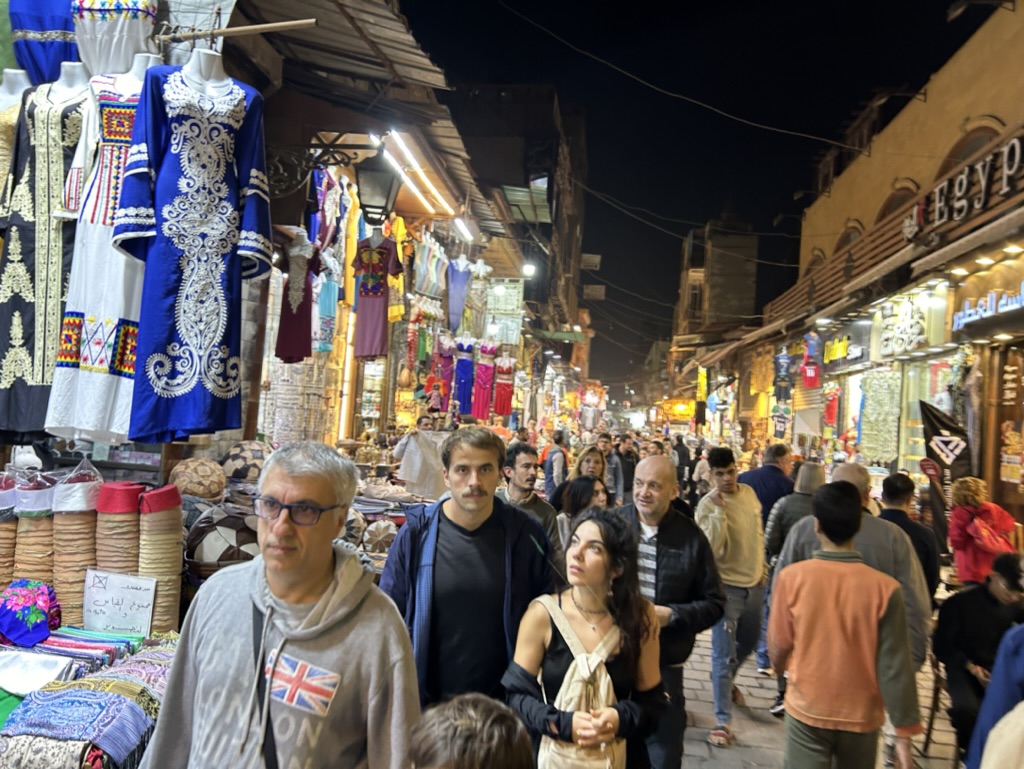
Later on, in the streets of Cairo, things got pretty funny. Our dinner tour included a walk through the bazaar, and bizarre it was. Hundreds of stalls of things for sale—brass, silver, clothes, lanterns, keychains, carvings, camels, all tourist items. There are 20 million people living in Cairo, and tonight on that 30-minute walk through this crazy place, it felt like we met a million of them. Black burkas were everywhere, kids in shorts or in strollers, men smoking, cats wandering in and out of shops, and scooters zooming along the cobblestones. Then our guide stopped us to point out that this medieval shopping area had an original arch from 1200 and that the wall surrounding it was actually a mosque that was 800 years old.

Gorgeous and yet bizarre. On the way back, John and I took the long and winding, “lost road” down passages with dead ends and more scooters squeezing by, all the while, vendors tried to get our attention: “Welcome to Arizona!” And “How can I take your money?” All very safe, but funny, indeed.

Dinner was traditional Egyptian fare: humus, tahini, eggplant, pinto beans, bread, okra, beef, rice, and rice pudding. Tasty! Oh, and the good news came before dessert. My suitcase was now waiting at the hotel! Huzzah!